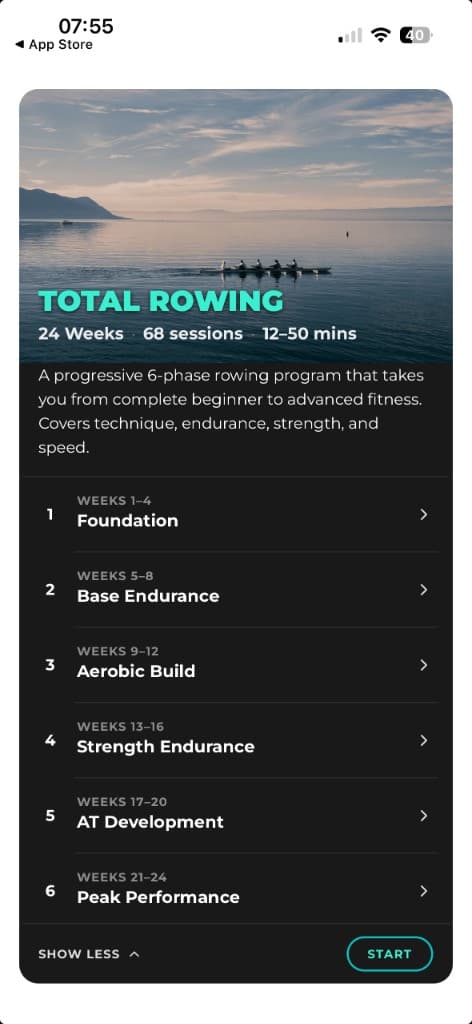
Most people buy a rowing machine, row hard for two weeks, then stall because there is no plan. Total Rowing fixes that with a structured six-month path: technique first, then aerobic base, then volume, power, threshold, and a peak month. This guide walks through every phase — what you train, why it matters, and how the app keeps you on track.
What is Total Rowing?
Total Rowing is the premium long-form program inside Rowing Machine Workouts. It is not a single four week block like Lose Weight or Max Power — it is a full six-phase, twenty four week journey designed to take a complete beginner to advanced rowing fitness.
- 24 weeks — roughly six calendar months at typical adherence
- 68 guided sessions — each with warm-up, main work, and cool-down
- 12–50 minutes — sessions grow longer as fitness builds
- Six phases — Foundation, Base Endurance, Aerobic Build, Strength Endurance, AT Development, Peak Performance
A progressive six-phase rowing program that takes you from complete beginner to advanced fitness — technique, endurance, strength, and speed. Sessions prescribe target stroke rates (SPM), show an intensity curve before you start, and include coach tips so you know why today's piece feels the way it does — not just how long to row.
The six phases at a glance
Think of Total Rowing as climbing six steps. You do not skip to threshold intervals in week one; each phase earns the next. Frequency rises slowly — two sessions per week, then three, then four in the final month.
| Phase | Weeks | Sessions | Frequency | Typical length |
|---|---|---|---|---|
| 1. Foundation | 1–4 | 8 | 2 workouts per week | 12–25 minutes |
| 2. Base Endurance | 5–8 | 8 | 2 workouts per week | 18–32 minutes |
| 3. Aerobic Build | 9–12 | 12 | 3 workouts per week | 22–35 minutes |
| 4. Strength Endurance | 13–16 | 12 | 3 workouts per week | 25–40 minutes |
| 5. AT Development | 17–20 | 12 | 3 workouts per week | 28–45 minutes |
| 6. Peak Performance | 21–24 | 16 | 4 workouts per week | 30–50 minutes |
Each phase explained — and why it matters
The copy below matches what you see in the app when you open each phase. Use it to understand where you are in the arc; the full day-by-day schedule lives inside Rowing Machine Workouts.
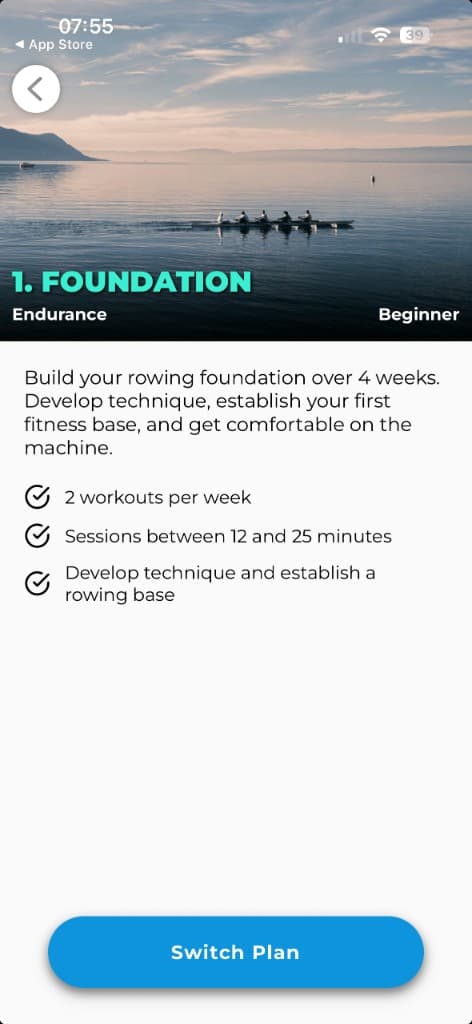
Phase 1: Foundation (weeks 1–4 · Beginner)
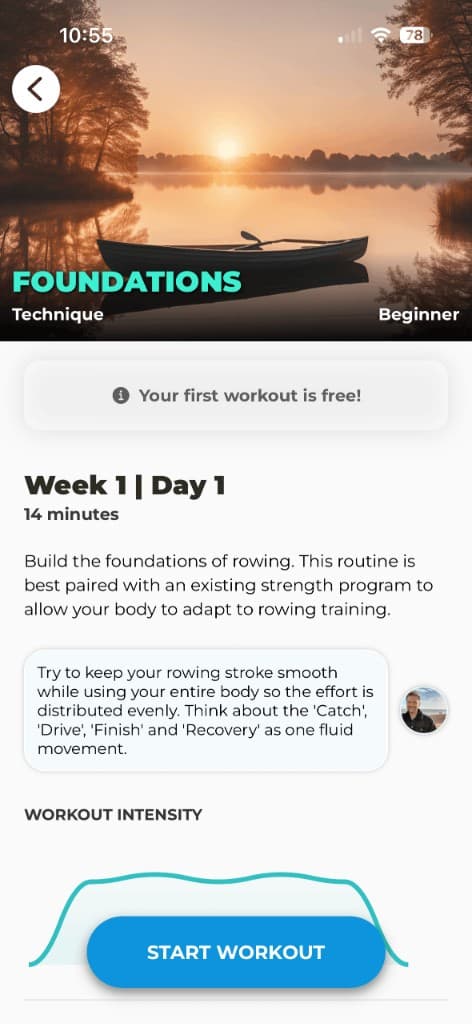
Build your rowing foundation over four weeks. Develop technique, establish your first fitness base, and get comfortable on the machine.
Program goal: Develop technique and establish a rowing base
Why this phase matters: Most people rush intensity before they can repeat a clean stroke. This phase keeps sessions short, teaches legs–body–arms sequencing, and introduces gentle SPM changes so you learn rhythm before load.
- 8 sessions across 1–4
- 2 workouts per week
- Session length: 12–25 minutes
Phase 2: Base Endurance (weeks 5–8 · Beginner)
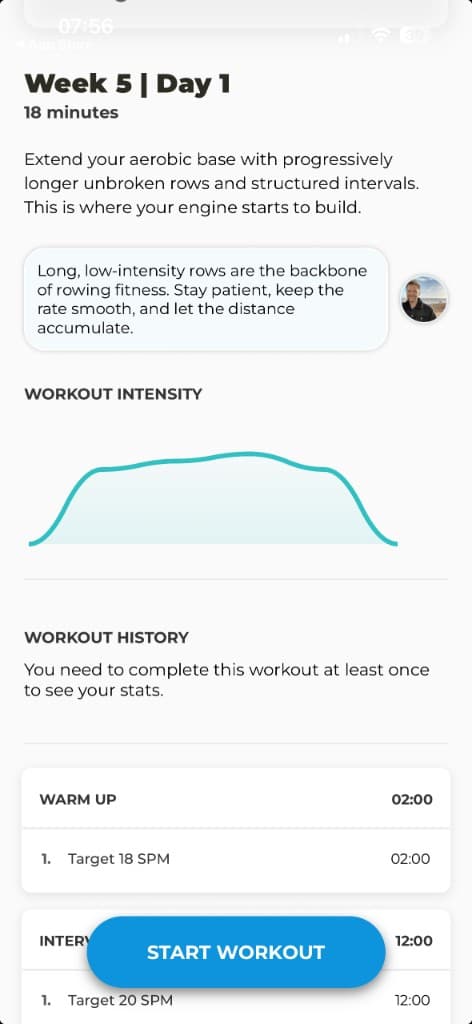
Extend your aerobic base with progressively longer unbroken rows and structured intervals. This is where your engine starts to build.
Program goal: Build a strong aerobic engine through longer steady rows
Why this phase matters: Aerobic fitness is the platform everything else sits on. Longer steady pieces and well-recovered intervals teach your body to use oxygen efficiently — the same capacity that makes later hard sessions survivable.
- 8 sessions across 5–8
- 2 workouts per week
- Session length: 18–32 minutes
Example from week five: longer unbroken rows and structured intervals with coach guidance on patience and smooth rate — the shift from learning strokes to building an engine.
Phase 3: Aerobic Build (weeks 9–12 · Intermediate)
Train three days a week with pyramid sessions, speed endurance intervals, and long aerobic rows. Your fitness takes a significant step forward.
Program goal: Expand aerobic capacity and introduce higher intensity work
Why this phase matters: Volume rises in a controlled way. Pyramids teach pace control across SPM zones; longer rows push duration; short rests force quicker recovery. You leave month three noticeably fitter than month one.
- 12 sessions across 9–12
- 3 workouts per week
- Session length: 22–35 minutes
Phase 4: Strength Endurance (weeks 13–16 · Intermediate)
Develop real rowing power through low-SPM power rows, sprint intervals, and mixed intensity sessions that push your strength and speed.
Program goal: Build rowing power, strength, and speed endurance
Why this phase matters: Endurance alone does not create a powerful drive. Low-rate power work and short high-SPM bursts build force per stroke and teach you to change gears — skills that transfer to racing and hard training pieces.
- 12 sessions across 13–16
- 3 workouts per week
- Session length: 25–40 minutes
Phase 5: AT Development (weeks 17–20 · Intermediate)
Push your anaerobic threshold with sustained hard intervals, hard steady rows, and speed work. This is where elite rowing fitness is built.
Program goal: Raise anaerobic threshold and sustain harder efforts
Why this phase matters: Threshold training is uncomfortably useful — the pace you can hold while breathing hard but still rowing well. Raising that ceiling makes everyday steady rows feel easier and improves performance at race pace.
- 12 sessions across 17–20
- 3 workouts per week
- Session length: 28–45 minutes
Phase 6: Peak Performance (weeks 21–24 · Advanced)
Train four days a week at peak intensity — long endurance rows, sprint intervals, threshold blocks, and active recovery. Your six-month transformation completes here.
Program goal: Achieve peak rowing fitness and advanced performance
Why this phase matters: The final month combines everything: duration, speed, threshold, and recovery discipline. Four sessions per week is a serious commitment — by week twenty-four you are rowing like an advanced athlete, not a beginner who found the machine last season.
- 16 sessions across 21–24
- 4 workouts per week
- Session length: 30–50 minutes
How a session works in the app
Every Total Rowing day follows the same rhythm: read the session goal, scan the intensity graph, then row with live segment prompts. Warm-ups and cool-downs are never optional filler — they prepare your heart rate and nervous system for the main set and help you leave the machine without dizziness.
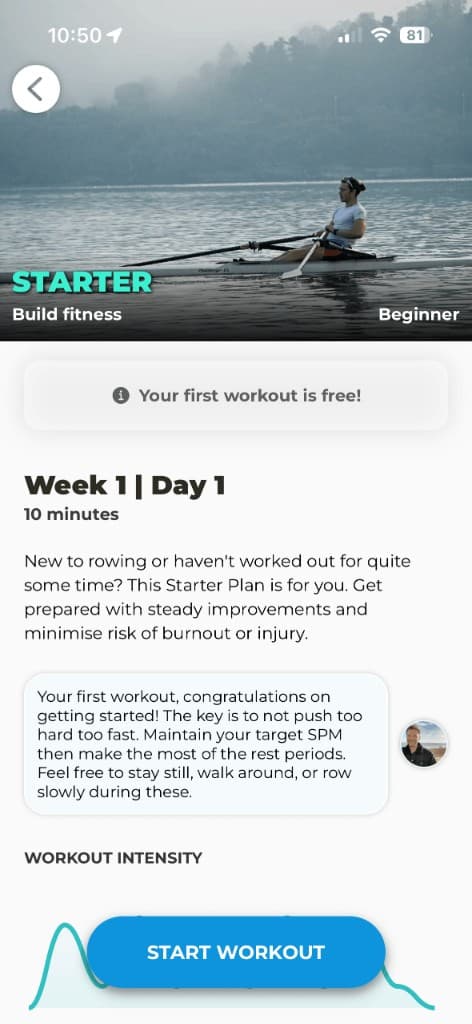
- Session intro — duration, objective, and a coach tip in plain language
- Workout intensity chart — visual preview of effort across the piece
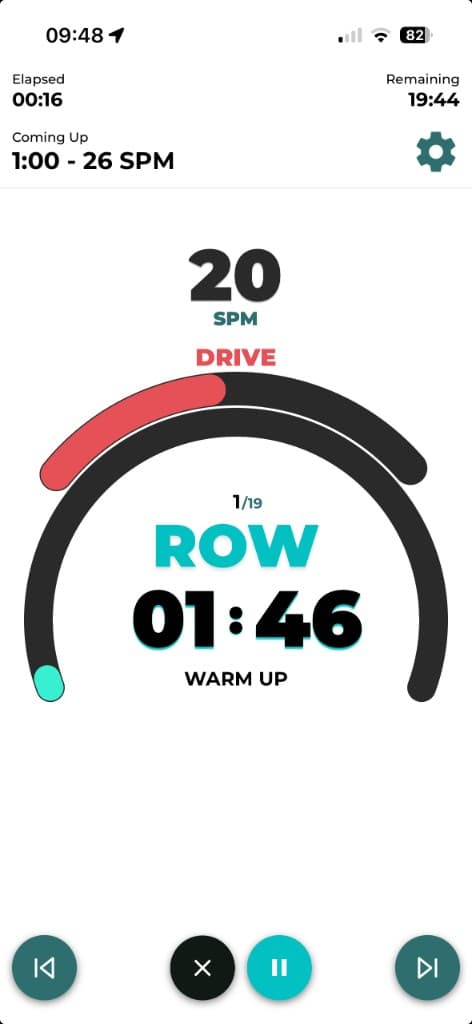
- Segment list — timed blocks with target SPM (e.g. warm-up at 18 SPM, intervals at 20–24 SPM)
- Live coaching — row versus recover, timers, and rate targets while you train
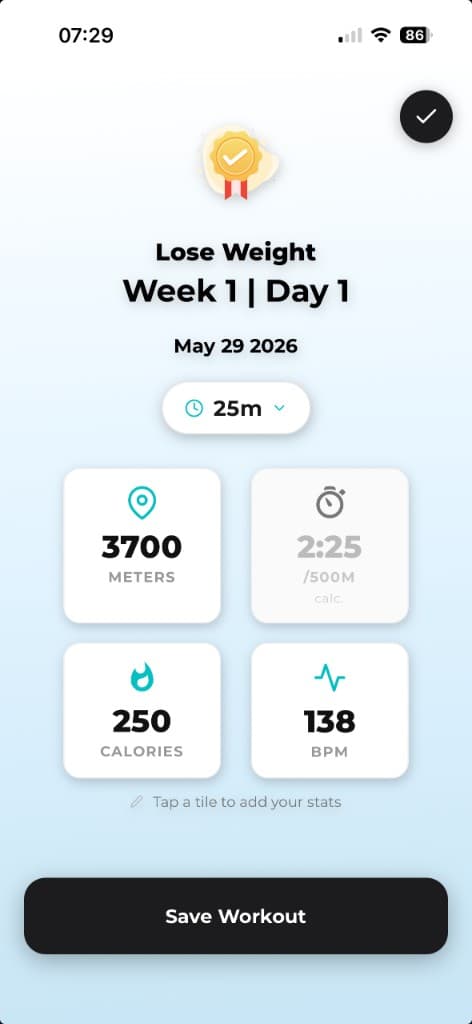
- Workout history — stats appear after you complete a session at least once
Hold your stroke rate with the SPM metronome
Total Rowing is built around strokes per minute (SPM) — the cadence you maintain on the rowing machine. Training the wrong rate is one of the fastest ways to stall progress: too fast early on and technique falls apart; too slow during threshold work and you never stress the right system.
Rowing Machine Workouts includes a built-in metronome that ticks at your target SPM so you can sync your drive and recovery without staring at the monitor. That matters most during long steady pieces and multi-segment interval days when rate drifts up under fatigue.
For a deeper walkthrough — when to use audio versus visual cues, how to match the metronome to prescribed segments, and common mistakes — read our article How the rowing metronome helps you train at the right SPM. Rowing machine with a basic display or none at all? See how to use a rowing machine without a monitor.
Workout history and stats across six months
A twenty four week block only works if you can see that you are showing up. Before your first completion, the app tells you that workout history will appear once you finish a session — after that, each row logs distance, time, calories, split, and optional heart rate in one place.
Over six months those numbers tell a story: steady-state pieces get easier at the same SPM, interval splits tighten, and weekly volume climbs without you guessing whether phase three actually made you fitter. Compare week five to week seventeen inside the same program — that is the proof Total Rowing is working.
How the six months progress
Months 1–2 (Phases 1–2): Learn the stroke and extend aerobic base. Two rows per week, shorter sessions, emphasis on smooth rate and patience. This is where beginners become rowers.
Month 3 (Phase 3): Frequency steps to three days. Pyramids, speed-endurance intervals, and longer aerobic rows — your calendar starts to feel like real training, not occasional cardio.
Month 4 (Phase 4): Strength endurance — low-SPM power work and sprints that teach force per stroke. You are no longer only building duration; you are building gears.
Months 5–6 (Phases 5–6): Threshold and peak. Hard sustained intervals, long endurance pieces, and in the final phase four sessions per week. Finish week twenty-four and you have completed one of the most comprehensive rowing progressions available in a consumer app.
If you need a shorter detour — fat loss or pure power — Vigour's four week weight loss plan and Max Power strength plan complement Total Rowing, but they are not substitutes for the full six-month arc.
Practical tips for finishing Total Rowing
- Trust the early phases. Foundation and Base Endurance feel easy on purpose — that is how you accumulate volume without breaking technique.
- Use the metronome on SPM changes. When a session jumps from 18 to 22 SPM, let the app hold cadence until the new rate feels natural.
- Do not skip rest weeks mentally. Even when frequency rises, easy days and cool-downs are programmed for recovery — respect them.
- Log every finish. History only builds when you complete sessions; partial rows do not tell the six-month story.
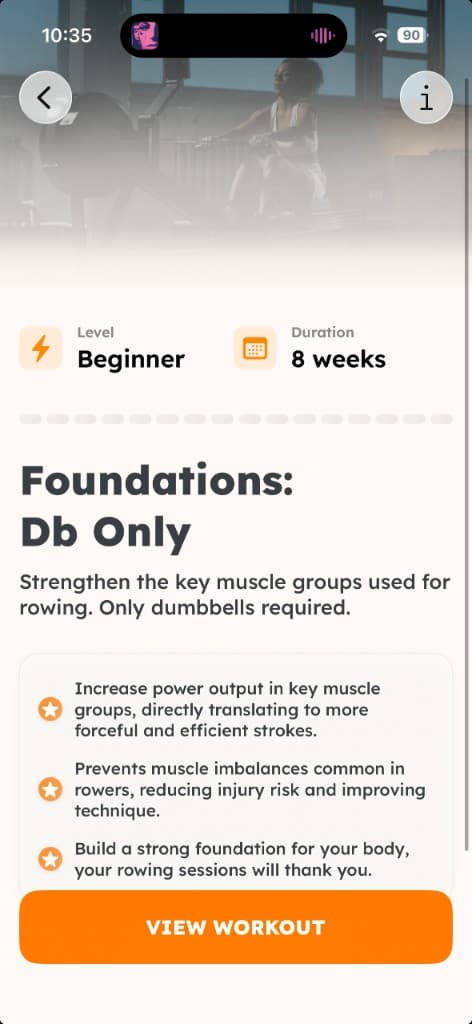
- Add gym strength if you want. Rowing pulls heavy; off-machine work like Foundations: Db Only can support your drive without replacing Total Rowing as your main cardio plan.
- Re-read coach tips. They explain intent (patience on long rows, form on power pieces) — the same advice a club coach would repeat on the water.